John Ford on Death's Doorstep
Greg Gerke
The image offered us by reading the poem now becomes really our own…It has been given us by another, but we begin to have the impression that we could have created it, that we should have created it. It becomes a new being in our language, expressing us by making us what it expresses; in other words, it is at once a becoming of expression, and becoming of our being. Here expression creates being.
— Gaston Bachelard, The Poetics of Space
I’m not sure that I’ve ever expected anything from a John Ford film. Two of his films that I’ve always had a fascination with, The Searchers and The Man Who Shot Liberty Valance, are probably those that many young men – or, more likely, young men years ago – seize on and gesticulate toward unknowingly in much of their public behavior, while trying to find a place in the simultaneously warming and cooling world. Yet the machismo inside them only goes so far. Ford’s world is full of quiet moments, with quiet men who speak short cryptic sentences. Many speak of the “poetry” in Ford, but I’ve often wondered if people who don’t know much about poetry use the word too liberally.
Of course, they mean to say Ford’s films are poetic, but what this translates into, as best as I can tell, is that they themselves are having a poetical experience, by which I mean they are experiencing some emotion that moves a finger to their lips, or their eyes to the sky—or hand to opposite elbow, à la John Wayne at the close of The Searchers.
If I know what poetry is, if I have studied it and given over many hours to reading and thinking and writing about it (all the same action), I dare myself to declare that what I experience in Ford is a relative of the feeling I get in Wallace Stevens, Marianne Moore, Eugenio Montale, Zbigniew Herbert: a poetic exhalation, and a nutritious sadness as well, a sadness that rejuvenates. Cinema is surely a larger psychical force than a poem, due to the production of motion pictures—a grandeur which might have its half-parallel more in nature, in landscapes; in the eye’s advance toward and recoil from the majesty, barrenness, or normality of the world out of doors. Poetry, for me, is a more private affair—not everyone can see it at the same time. One person reads and there is a clandestine, quasi-religious experience between poem and reader, while another stumbles over the same poem or comes to the end and is unfulfilled. The poetry of the screen and the poetry of the page contain similar electrons shooting at our bodies to produce diverse phenomenological responses – delight, repugnance, even ellipsis – though the staging in each form is different. Cinema runs the image before the eyes while, at the same time, the mind can pick it apart, bring about ruination, fragmentation. Poetry holds words and silences (and ghosts of words) to the light and brings images in and out of shadow, as the words dissolve and reintegrate with the images of our daily life.
I’ve often wondered about the private aesthetic experience: what goes on, what reorientations occur in the mind and the body. I picture a massive rock face coming free from the side of a mountain to make a new cliff—how it crashes into water, or piles up as a new heap through breakage on the ground. Our world changes, but only we feel it (though we can’t always say for sure, and sometimes not for ages). We can lay it out in narrative to our lover, but it is a paltry tale. I have to think that people who do share a similar aesthetic experience through books, paintings, plays, and films, come together and can say only, It was stunning. Though they recognize the effects in another person’s soul, demeanor, the scale of their face, their posture as they look at a book or stare at a Cézanne—these “silences” and these genuflections are noted. We communicate before being understood, as T.S. Eliot once said of “genuine poetry.”
I find a corollary in the supreme book on John Ford in English—Tag Gallagher’s John Ford: The Man and His Films: “Around 1927,” Gallagher writes, Ford awakened “to cinema’s ability to be art through total stylization, awakened simultaneously to his art’s high task: to help us free ourselves from determining ideologies. Art, after all, has the capability of making us understand things through emotion that we would be absolutely incapable of understanding through the intellect.” This stance, undoubtedly true, is hard to grasp until there are a few lines on the face, which might explain my late return to Ford.
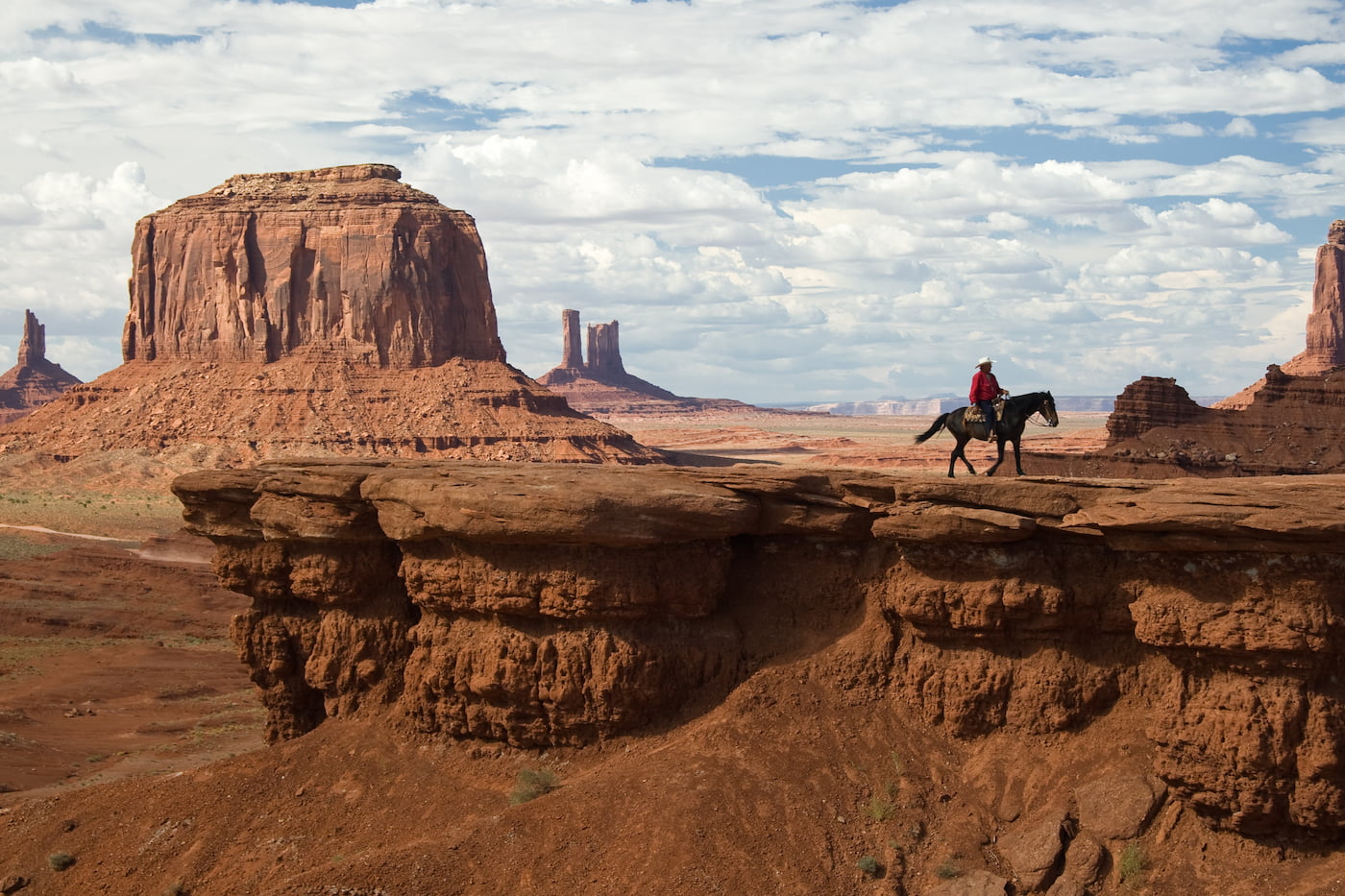
Even if I wasn’t watching John Ford films, they were on in the background of my early life, along with Hitchcock, the Cary Grant films made with that director and with Howard Hawks, Laurel and Hardy, and so many others—and I could watch all those other films and enjoy them to varying degrees, but Ford I kept at arm’s length. (Or did he keep at arm’s length from me?) I have to think the fact of the small screen had a role in this estrangement. Comedies play better on the tube, the mise-en-scene is closer to the sitcoms my generation grew up on. It’s hard to make out distances on a curved 18-inch Sony television. I would look at 3 Godfathers or She Wore a Yellow Ribbon on the screen, but I just saw some overarching Monument Valley sun high atop stick figures, with fifty miles of landscape the size of my two hands. So, perhaps it’s not surprising that the first Ford film I latched onto was The Man Who Shot Liberty Valance, due to its rather indoor medium-shot-dominated layout, the well-known lead actors, and the mystery element of the plot (signalled ahead of time by the title).
In going back to Ford, a certain conundrum comes out—the beauty, the “poetry” or the feeling of a poetical experience is rarely experienced in the blustery moments. The “poetry” is part and parcel of the quiet moments. This gels with Ozu’s comment: “Look at Henry Fonda in My Darling Clementine: motionless and expressionless—there is the greatness of John Ford.” There are other moments: Ben Johnson whittling a stick while talking to the Mormon leader played by Ward Bond at the beginning of Wagonmaster, or in Young Mr. Lincoln when the mother, nestled among her family in a jail cell the night before the verdict, grimly looks at her son (on trial for murder) and his wife and child. In these moments the characters have communicated before being understood, because hardly ever is it the words in cinema, but the action and facial expression that cuts us to the quick—the secret of filmmaking, per Ford, was “people’s faces, their eye expression, their movement.”
When Ford, according to Gallagher, treats “people as archetypes and quotidian events as sacred ritual,” he puts the tectonic plates of aesthetic experience into play. “The result of Ford’s objective camera style is that we do not ‘identify’ with the characters… we stare at them and relate to them,” Gallagher writes. “Hitchcock’s movies contrast violently with Ford’s, so intensely subjective and manipulative… whereas with Ford, no matter how intensely emotional, we are also critical, judging witnesses.” Here lies the power and the poetry of Ford. Jimmy Stewart’s Scottie in Vertigo is obsessed and vindictive and lost, but the same actor’s Ransom Stoddard in Liberty Valance quietly lives the lie his successful political career was built on. And in some transfiguration his lies and oily politician mannerisms can only take him so far. A symbol returns: a cactus rose blossom that Tom Doniphon, his rival and friend, gave Stoddard’s soon-to-be wife all those years ago, placed now, by her, on Doniphon’s casket—a time capsule on which he starts to metaphorically prick his fingers while taking the train out of town, as if in the last sullen minutes of the film he might begin to see that he, Stoddard, is Doniphon’s true killer.
Sometimes the “poetry” will come out of nowhere and it might be so stunning a caesura in the midst of a heavily plotted Hollywood film that I will want to stop the film and say to my wife, Did you see that? How incredible was that? One such scene, about halfway through Cheyenne Autumn: As the U.S. Army leads the Indians to their traditional home in Wyoming from a reservation in Oklahoma, a young Second Lieutenant Scott, incensed about the Indians (whom he hates) rides up to Captain Archer. As their horses move against that big sky of the Southwest, the dialogue goes as follows:
Captain Archer: What put the blood in your eye?
Scott: It’s just a private matter, sir.
Archer: Nothing that affects an officer’s conduct is private.
Scott: My father died in the Fetterman Massacre back in ’66. I was only ten…
Archer: Well, that doesn’t give you a personal license to kill Indians.
Archer then threatens Scott before Scott retreats on his horse, but Archer soon calls Scott back. “I knew your father,” Archer says, right before charging ahead on his galloping horse, not waiting for any reaction—Ford gives Scott barely any reaction time except the start of an open-mouthed gape; he knew the audience would fill in the pathos of the moment.
One might say Ford is all emotion because this is what Ford was—he hid his true self in the art. He gave the people closest to him some version of a counterfeited self, he gave the world the emotion. We speak through art to communicate with the ghosts we wish we could see more of in waking life—Ford has at least ten prominent scenes of characters talking to the dead at the graveyard or in the presence of old pictures. There is a directness in Ford that can be disarming.
*
I had the question: Why Ford? A beautiful challenge. I didn’t want the answer from a book, or any biographical information. I wanted it only through aesthetic experience, but I couldn’t help myself. Still, the more I read critical books or single essays on Ford—and I threw most of them to the floor in disgust—the more I believed too many had misunderstood and underrated him, while at the same time projecting things that weren’t there. (That they tried to explain the films to me didn’t help.) I felt akin to Madame Merle, the indelible fortune hunter in Henry James’s The Portrait of a Lady, who schemes to get Isabel Archer married to a repellant old flame of hers (she has a grown daughter by him): “It isn’t information I want. At bottom, it’s sympathy. I had set my heart on that marriage; the idea did what so few things do—it satisfied the imagination.” I too desired sympathy, to satisfy my imagination.
Later, I finally did allow three writers to guide me: Gallagher, as mentioned, but also Gilles Deleuze and Serge Daney. They told me more than any biographical detail could, and their words imbued the films themselves with a secondary aura. I didn’t want to get close to John Ford the person, but to more embrace what he became—the holy mountain of over 140 films, the person who more than Hawks or Hitchcock, more than any politician or artist in the 20th Century, except for William Faulkner, built lasting myths about the US, particularly concerning the West. These same myths he simultaneously dismantled, especially in the last two decades of filmmaking, though it probably starts as early as Young Mr. Lincoln. As Deleuze writes, “…the American cinema constantly shoots and reshoots a single fundamental film, which is the birth of a nation-civilisation, whose first version was provided by Griffith.” The most crucial quote is from Daney:
Ford is one of the great artists of cinema. Not only because of the composition and the light of his shots but more deeply, because he shoots so quickly that he makes two movies at the same time: a movie to ward off time (stretching his stories, for fear of ending) and another to save the moment (the moment of the landscape, two seconds before the action). He enjoys the show “before”… So, with Ford there is no point looking for characters who, in front of a beautiful landscape, would say “How beautiful!” The character is not to whisper to the spectator what he should see. That would be immoral.
People see Ford and they fit him into some ancient box, with some saying he was a reactionary, or a crypt containing an 18th century oil painting, a Hogarth perhaps, or something just as out-dated. For me, meanwhile, an encounter with Ford is Shakespearean, Vermeerian, and Joycean, with many planes and vectors of artistic expression breathing all about the space in my head due to Ford’s double-jointedness and deft adaptations.
The Searchers doesn’t take place in the year of its production, 1955, or in 1868 when it was set, it takes place in the eternal present (Borges: all the books in the library are contemporary) and is as alive as the trees lining our neighborhoods, parks, and plots. Kent Jones wrote that “one might spend a lifetime contemplating The Searchers or Wagonmaster or Young Mr. Lincoln and continually find new values, problems, and layers of feeling.” I was only getting started.
It isn’t fully necessary to know about Ford’s methods: his style is decidedly unflamboyant, the exact opposite of Orson Welles’s. (The men are inexorably linked because the latter came from the former, literally using Ford’s cameraman Gregg Toland.) This was a man who never storyboarded a shot and just went to the set and thought about things—saying, for the infamous scene by the river in Two Who Rode Together, “this is where the camera goes”; that is, the camera had to be stationed in the river to capture the men sitting on the bank talking. (Jean Renoir, after watching Ford: “Today I learned how not to move my camera.” Richard Widmark, who starred in two films: “Ford didn’t move the camera, he moved the people.”) Ford’s method of poetry is so elusive that there is barely any formula to it—“I cut in the camera,” he said. He learned on the job, first directing when he was twenty-two. With most of his silent films now lost, people often take 1928 as the year he first started to make pictures on another level, beginning with Four Sons, an imitation of Murnau. (Murnau’s Sunrise was, he believed, the “greatest picture that has been produced.”)
What would this lead to? Monument Valley and Moab, Utah. Ford’s being is in those locations. All the gruff machismo – the Irish-American bullshit bru-ha-ha – is there and well-documented (Jimmy Stewart: “There’s always tension on a Ford set”), but why did this seeming brute and struggling alcoholic feel compelled not only to unsettle human civilization, but to redefine it, on his own terms? This is unconscionable but not inconceivable. There are no easy answers and none that will fully satisfy anyone. Deleuze: “What counts for Ford is that the community develops certain illusions about itself,” something he nodded to directly in life: “We’ve had a lot of people who were supposed to be great heroes, and you know damn well they weren’t. But it’s good for the country to have heroes to look up to. Like Custer—a great hero. Well, he wasn’t. Not that he was a stupid man—but he did a stupid job that day.” Again and again we see the community coming to embrace the “hero,” even in The Quiet Man, where the native Irish adopt the Yank as one of their own.
*
Maybe it was while wandering joyfully yet strangely through Cheyenne Autumn and the aforementioned scene that I began to descry a new feeling. I began to see Ford’s artistry emerge out of shadow and, just as Barthes remarked that he began to read all the writers before Proust according to Proust – Flaubert, according to Proust; Balzac, according to Proust – I thought that I must now view all other directors’ films in light of Ford, especially those of Welles and Kurosawa. But the new feeling? It was the endpoint of everything Renoir, Ozu, and others had said: Ford could see everything. The complete divination of even the most minor character should put us in the mind of Shakespeare stenciling out the exact qualities, station, or facial expressions of even the most insignificant person on stage. I think this is best illustrated in a Cheyenne Autumn scene showing someone with barely a few minutes of screen time, Sergeant Wichowsky. One night while drinking, he reveals his history. His enlistment has expired and he tells the Captain he won’t re-enlist because he’s a Pole, saying “[Cossacks] kill Poles just because they’re Poles, like we’re trying to kill Indians just because they’re Indians.” People for the most part don’t drift and dream in Ford, they are doing, asserting, they have to get somewhere—if they didn’t have this they would go into a drunken stupor, as evidenced above. Some might ascribe moral ordering in this deep feeling but Daney would cavil: “the character is not to whisper to the spectator.”
Dreyer, Ford, Mizoguchi, and Ozu all started in silent films—the birthdates run 1889, 1894, 1898, 1903—and they exhibit a beguiling capacity to play images off each other, I think because they learned the visual first without sonic accompaniment. It is no wonder they carry a certain ancientness with them (in ways that Kurosawa and Welles don’t)—I sense Greek and Roman stone in their images. They make, relatively speaking, the most sad, bitter, and tragic films. There is a fundamental quality, a classicism inherent in the infancy of the art, that these directors (and a few others) maintain within themselves. One could nominate one of the main pillars of US letters, Ralph Waldo Emerson, to honor the effect:
You are one thing, but Nature is one thing and the other thing in the same moment. She will not remain orbed in a thought, but rushes into persons; and when each person, inflamed to a fury of personality, would conquer all things to his poor crotchet, she raises up against him another person, and by many persons incarnates again a sort of whole. She will have all.
All great cinema has this protean duality, but Ford’s films carry the second part of the quote, as if in remembrance of Daney’s words—to save the landscape. How does Ford plumb the depth of feeling of the human being under nature, where he will live and die? Wherefore poetry? Robert Frost’s ‘Desert Places’ is the fit analog for the stare so many of Ford’s characters take on as they navigate a land emptied of the people they no longer love in life:
And lonely as it is, that loneliness
Will be more lonely ere it will be less - A blanker whiteness of benighted snow
With no expression, nothing to express.
They cannot scare me with their empty spaces
Between stars - on stars where no human race is.
I have it in me so much nearer home
To scare myself with my own desert places.
It’s not only that Ford’s films are often ghost stories, but that there is another presence in Ford, something wholly uncanny. Deleuze gives a name to the force: “the great encompasser,” with the ultimate in Ford being “the sky and its pulsations.” The sky, above the land, where people die and go on living—history. But how to meld that with human emotion?
In continually grasping to define it, I grabbed Hegel’s aesthetics and what they conjured fit Ford well: “The sensuous shapes and sounds of art present themselves to us not to arouse or satisfy desire but to excite a response and echo in all the depths of consciousness of the mind.” Consider the beginning of Young Mr. Lincoln. Young Abe has been given law books and lays on his back, feet stuck on a tree while reading, as a woman enters the frame: Anne Rutledge, who enlivens Abe during a tender walking scene by the river – concluding in cryptic but direct dialogue (“You’re mighty pretty Anne.” “Some folks I know don’t like red hair.” “I do.”) – and is buried in the ground in the next. The river in summer becomes a river of ice in winter, and Abe is walking again in a similar spot but all bundled as he bends over Anne’s grave, near that now trudging river. Life and death, one after another. We see the endpoint before we know the cause – Bresson: “The effects of things must always be shown before their cause, like in real life.” – leading to a harrowing echo of how it really feels to lose someone: they are there and then they are gone. This is the pinnacle of the feeling of two films at once, warding off time to save the moment: Et in Arcadia Ego. We die as we live and others die so we can live. They tell us how to die when we must.
The ghost behind Ford for me is my father, but I didn’t watch the films to get closer to him because I was already close to him, even if he was dead. I sat at his feet watching him watch these and other films for years, but I could not see until these sadder days that, yes, they were expressing him by making him what they expressed—an astonishing thought, and one he communicated to me in the simplest fashion possible: “I really love those John Ford films.” His remains can be superimposed over the buried Anne Rutledge in the graveyard in Illinois, or in the casket in Shinbone (in an unnamed Western state), where Stoddard upbraids the undertaker for not having Doniphon’s boots on his dead feet—an Egyptian flourish in the New World’s lawlessness. And, returning to the film again, the grace notes abound—the glances between Hallie and Liberty Valance himself, halfway through: decades of masculinity noted, and lust thwarted. These poetic images of Ford, these heavy glances, drilled heart shapes and high signs into my stone, as well as cross-stitching the public tapestry that represented myself, my age, and my companions: how we dare each other to break, how we teach each other, how we fear women rather than a gun, or how Ford might have loved other women but stayed with his wife—it is no wonder Henry James said a writer makes his readers just as he makes his characters.
*
So I sink into my country and into Ford’s art and in my mind’s eye, like Hew, the narrator of How Green Was My Valley, whose father has died in the mines, I give myself a happier ending than I deserve, when he says, as an adult: “Men like my father cannot die. They are with me still, real in memory as they were in flesh.” Yes, I reward myself with Ford as each long day closes, and what does Ford’s “poetry” tell me? Be kinder, but know that being kinder is not enough. One day, you may come home from work and someone will be gone, forever. So don’t live all you can, but live and you shall see everyone you miss in the others that make up your life. That is the gift art can pave a way for—the miracle to happen, as well as being a miracle itself—something some stranger gave us to help. In that light I return to Robert Frost, and that strand:
The land may vary more;
But wherever the truth may be---
The water comes ashore,
And the people look at the sea.
They cannot look out far.
They cannot look in deep.
Click here purchase the issue in which this piece originally appeared, or subscribe to receive all future issues as soon as they're published.
You can subscribe to our infrequent newsletter here: