Nothing Except Nothing: Living with Duras’s Cinema
David Hayden
Senses in a room. A presence that cannot be evaded. A presence towards the world of another: a film. The sound coming through the forest, the dogs in the woods, the constant noise in Baxter, Vera Baxter that is memory, that is the presence that feels in the recycling moment, that is the unnameable approaching. There are paths out to where what endures might be found.
The roll of the film does not abolish chance. The films act on and in the body. The viewer is spectral, grossly physical, thrown into and out of time, before and beyond their own time. The subject is the events, the actions, that will not leave us, that return to us as we return to them, that are in and out of the frame of sense and mind.
We are made present to our temporary existence, to the temporariness of our existence. We are made present to our pre-existence and our non-existence. The cinema of the despondent and the comic. I watch alone. Or I watch with another, alone with themselves, and the time that passes returns when we remember the film, when we talk about it after the lights go up, and perhaps again or never again.
There are different approaches to cinematic intelligibility. Those that focus on plot, action, character, arcs of narrative, of emotion, of development, can seem most accessible, most readable, memorable, shareable, admirable. Discontinuity, repetition, asynchrony, slowness, emptiness, mismatched sound and vision, are baffling and distasteful, signifiers of bad filmmaking, of a superior attitude to the viewer. Films are rare in which a woman’s voice narrates, or memoirises, contends or unspools or constructs thoughts. Duras allows us to see, hear and remember, how little and at once how much—how excessively much—we can apprehend in silence, in emptiness.
Of her 1969 film Détruire, dit-elle (Destroy, She Said) she said: “I came home. Home to my fear, I mean. At home, but in my fear. And at the same time, entirely free. But in a state at being so…” A cinema of fear, at home in fear, in a state at being at home in fear, a singular and convincing kind of realism for those, like myself, who have been shaped by fear, fear at home.
The cinematic experience comes through the eye and the ear, but the work of meaning, what is felt and understood, or not felt and not understood, is not solely ocular and auditory, but happens, and is made to happen, in the entire organism of the viewer, and in the audience, or audiences, that the viewer is part of, whether in a physical cinema or elsewhere, with companions or alone. Cinematic experience is passive and active, conscious and unconscious, directed and non-directed, attentive and inattentive, happening in the time shaped by the collective known as ‘the filmmaker’ and in the spectator’s time—their total temporal extension. Film extends to the spectator, endlessly, a touchless touch. We are moved, we are reached where we live, in ourselves, we visit, we are visited, we feel within us the marks that the film has made, or we don’t—the experience running off us, leaving no memory, or the memory of no memory. I am moved, I am reached, I am visited, I remember, I forget. A touch that sinks into us, into me, not as a discrete object, but radiating or transpiring throughout, energising initially, but adding to our organism, alimentarily. I am fed.
The filmmaker uses their means to infer the senses that cannot be experienced directly in their medium, and we understand and respond because we are inferential creatures, beings who, to differing degrees, are capable of taking limited cues and making from them a total experience of time, place, sense and meaning (including meaninglessness). The film begins and we are open to the task of making, or not, accepting, partially or totally, the filmmaker’s skilled or clumsy enactment of their intentions, and our own—we chose this film, or didn’t, or did reluctantly, but we choose what we will do with the experience within our capacities and out of our biographies, except where we cannot help ourselves in our responses, and we do this with all the senses available to us. We cannot do otherwise. I cannot do otherwise.
The filmmaker’s means: images moving, spectra of colours, including black and white, images still, sound and silence, inside or superadded to the film world.
Duras’s films resist consumption, resist being concluded, have return folded into them, not only through the repetition of themes, characters and situations, across the films and the books, but by the presence of unresolvable stillnesses, of bodies, of stones, of rivers, of seas, of rooms, of houses, of corridors, of shores, of unfathomably memorable vacancies. Her rewriting and recycling incites rereading, reengagement. The unplotted presences are resonant with those of the spectator: our bodies, our shores, our rooms. The house is empty, the story comes to inhabit the house, the room, the shore, the body, the forest, and then it departs, leaving its shape, its impression, its shadow, its warmth, its chill.
The films were often made cheaply using locations near her home at Neauphle-le-Château, her apartment in Trouville, the abandoned Rothschild palace in the Bois de Boulogne. The cast and the crew regulars, including several of the greatest post-war actors: Jeanne Moreau, Bulle Ogier, Michael Lonsdale, Delphine Seyrig, Gérard Depardieu, Matthieu Carrière and Dionys Mascolo. And, over and over, Duras’s own voice.
Our thoughts are synchronous with the reality we perceive eventually, although we might force them to align in order to function well socially and practically. In the present we are who we were, some fragment of who we were that may have existed in the world only fleetingly but persists as an echo that has a constitutive power in the now, whether we can name it or not. The once existent might be corralled and made visible within a psychological theory, but it cannot be named or seen or plasticised or altered. Duras made a cinema out of these non-materialities that might be called memories or selves, a cinema that destroys one artifice called realism and creates a new realism that disrupts and complicates the filmic illusion of coherence, which does and doesn’t have a referent in the lived world.
I feel the warmth of the recalled summer in the voice and the cold of the winter hotel in the images of Agatha et les lectures illimitées (Agatha and the Limitless Readings). The polysemous self knows and feels much that differs, that relates or has no obvious points of connection. The sensorium of memory, all time lost and found in the body. Image at a distance, sound, the voice, up-close, intimate. Nothing happening, silence, the portrayal of loss, of lack, of connection, of power, of motive force, of memory, of agency. The viewer inhabits what cannot be shown. The absence of speed. The films are not hypnotic, not oneiric, they produce an intensified wakefulness. Each spectator is invited to see, to make, their own film by watching Duras’s films, the ways the film’s aboutness are presented have the power to evoke but do not displace that power in the spectator. Inspired by visuality, the moment of desire to touch before touching, the touch that never happens, is a suspense of intimacy, pleasure, pain, and insensateness that comes in through the eyes and ears, a pre-haptic sensation, tactility approaching but never arriving. The maddening desire, the thwarted relation, the agony of proximity, the coming apart through apartness, of the Vice-Consul in India Song.
Silence and sound alike are inescapable in the filmic experience. The soundtrack exists to provide access to intrafilmic realities of speech, action sounds, textures of time and place, felt sound such as music, or outside the film’s immediate world, to intensify meaning and feeling, or provide a commentary on the film narrative. Aural presences, human and non-human, word and non-word based have equivalence to image in Duras’s films. The non-visualised voice, the temporal dislocation between voiceover and that voice’s presence on screen, such as in Billy Wilder’s Double Indemnity. The scream of birth, of separation, the scream of grief, the call of death, in India Song.
The silence in a sound film is not the silence of a silent film, it is a semantic element, purposive and creative. “In ancient times, in the past, for thousands of years, silence is women,” said Duras. Silence in Duras, as in the cinema of Chantal Akerman, is placed there to be heard, for its non-verbality to be tangible. Silence vivifies perception of the inner and outer, it sharpens where a person is and was in place and time, it can erode the present and push forward past experience thereby displacing the present. Michelle Royer in her The Cinema of Marguerite Duras: Multisensoriality and Female Subjectivity writes: “What Duras wants spectators to hear is not so much the meaning of the dialogues, which is often illogical and incoherent, but the rustling of the body, the presence of the flesh, the rattling of the air against the vocal cords.” Sound is a form of knowledge experienced with immediacy and inescapability, as Royer puts it, “that extend beyond cognition and understanding.”
A film is an assemblage, continuity might be designed and/or read into the film. The notion of a film’s totality might be experienced in recollection, or a totalised film might fall apart when recalled. Duras sensitises the viewer, the viewer sensitises themselves, to where they are in place and time, where they are relative to the sounds, visions, and idealities of the films’ performances. Cinematic absorption is possible, but so is disabsorption into modes of questioning or not questioning, complicity and refusal, discomfort, inattention and boredom. As Elizabeth Groff writes in her Visual Duras: The Paradox of the Image in the Cinema of Marguerite Duras, “time escapes its subordination to the unfolding of action or movement.”
Duras was fascinated by ‘dead time’, the time as we experience it in what Marc Augé called non-spaces. Yes airports, stations, lobbies, corridors, but extended to other times and places, a hotel room with an ex-lover waiting for their other to leave, in a kitchen, as in a scene in the film Nathalie Granger that is both hilarious and sinister, being sold a washing machine by an incompetent salesman, a model that one already owns. The quality of this time can be a solvent of the self and when reproduced as a habitation for the film spectator can in turn reproduce that dissolving effect. The non-self that one degrades to might be no better than the person that one usually is, or is perceived to be by others, and no less a fiction.
Duras is concerned with what we cannot see, what cannot be visually represented, which she shows through the reactions of the figures or characters and apprehended via the sound world of the films. What might be a single character is sometimes split into parts, such as Stein and Max Thor in Détruire, dit-elle, or possibly the figures on the beach in La femme du Gange (Woman of the Ganges), the ‘Jews’ in Jaune, Le Soleil. This intersubjective characterisation exists between other figures in other films, and beyond the idea of relatability might, or might not, extend to a spectator. That is, we can intensely feel some aspect of our life, mind, self-apprehension, that we want to flee, have lost and want to repossess, inhabit but namelessly, that live with us during the screening or afterwards in recall. There are Duras’s people without qualities, like Musil’s, without qualities to or in themselves: the salesman in Nathalie Granger, the love-wrecked in Le Navire Night, the man in L’homme atlantique.
The experience of cinema is multidimensional and simultaneous, that is we see and hear and feel in instantaneous response to the elements placed before us by the filmmaker. Our responses are our own. What does the simple image of the cold northern sea make you remember simultaneously, spontaneously with its appearance on screen? Is the feeling the same each time? Duras anticipates feeling in response—individual and collective responses—that her film is the occasion for but not the instrument of intended production. Duras creates spaces for mystery, both specific and generalised. The setting on-screen, the setting in-sound, the setting of the spectator-auditor. The placeness and displaceness of being.
Duras makes tangible the various forms of the cinema’s madeness: time, space, bodies, memories, light, darkness, emptiness, fullness. We are full of our experience. In any emptiness, darkness, on screen we will find ourselves. In any silence we will hear ourselves.
Imperception is the greater part of life. The flow of what is not grasped is a feature of Duras’s films, the images and sounds are not artefacts of the unconscious or dissociative presences but presences outside of thought known passingly to the senses, which may or may not leave traces within us, which may always be partial and do not have to be true to their sources.
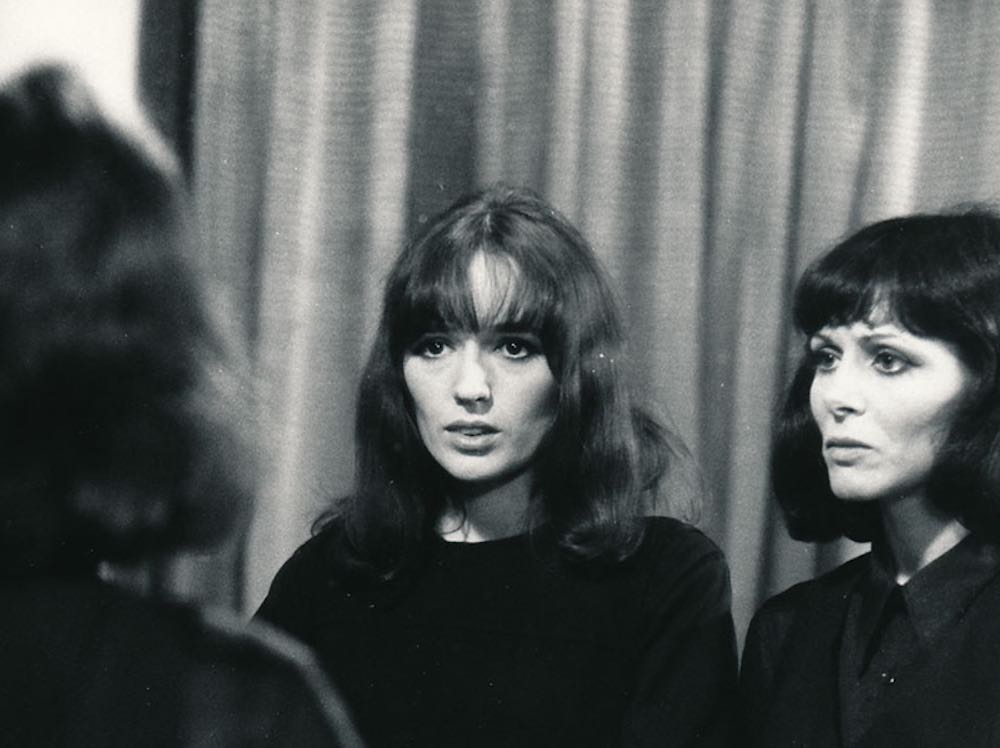
An isolated hotel in the countryside that might be a sanatorium, a rest home, or an asylum, with four residents but no visible staff. Elizabeth is recovering from a miscarriage, Max Thor, a professor of ‘future history’, and Alissa Thor, husband and wife, and Stein, a writer. Some kind of love relation might exist between them in a complex of combinations. Almost a fifth character is the forest beyond the grounds, a place of fear, mystery and otherness, and the source of sinister sounds. Elizabeth’s husband arrives and there is an ending. The film might be about the possibility of connection, individual and collective, and the means and the forces, internal and external, that might hold together, or break apart, the self and the other. This makes it an intensely, if obliquely, political film, one with a palpable, dark optimism.
Duras’s is a cinema of unlimited readings that can lead us to conclude that all cinema is so. Cinema proceeds not only by the succession of one sensory element (image and sound) by another by displacing or overlaying or integrating with whatever elements the spectator may have in mind. This is a major source of the relief that spectators experience in seeing films. We can be relieved of ourselves, specifically those images and sounds that are interior and persistent. Even where the cinematic substitution or projection is tragic or horrific it is a relief because it is not ours, and unlike ours it comes to an end with us intact. I want to be relieved of myself, I want to be returned to myself, I want to be awakened by cinema.
The subject and the enactments of Duras’s films is power and powerlessness, in the sense of capacity and incapacity: can we remember? Can we forget? Can we know ourselves and others (should they exist, or after they exist) Can we know a place? Know a time? Can we bear time? Bear place? Can we read? A book? A film? A sense? A time? Can we change? Social or individual relations? Individual or national reflexes of violence, of domination? Can we see or hear with purpose? Can we be together? Productively? Pacifically? With kindness? Can we feel? Can we bear to feel?
What happens in the cinema without persons? Where there is a spectator there is no void. The machinery operates. Humanity has left the room, departed the world, the film unfurls, analogically or digitally, impossibly. There is no spectation, no hearing, no regard, no perception of the seat, the room, the others, the body. Duras’s are the films for the cinema after time, after us (as might be the films of Michael Snow, and others). My thoughts are in the future without us, without me. These may as well be the work that I do with these films, my recollections of these films, placing them in the cinema that will never be, after time.
What happens after the destruction that leaves the person alive? In Duras’s case a state of graces and a set of strategies that enact that grace—that intense, agentified curiosity—so entwined with suffering and the desire to drown the afflictedness in alcohol, drown the body in smoke, drown the pain in love, drown the suffering in language while speaking of it and others. “Grace is what I choose to call the phenomenon that is curiosity about the other,” said Duras.
About Jaune, le soleil Duras wrote: ‘It is crucial to feel in this film the deprivation of the comfort provided by commercial cinema. We have nothing to do with that.’ The ‘no comfort’ and the discomfort are a source of something like pleasure, as are the human presences on screen, and its cinematic virtues, its beautiful or attractively ugly shaping of sound and silence, of light and dark, as are the memories of having watched the film, as are the experiences of re-watching Duras’s films. The thought of Duras’s cinema as something that a person made, that a few or many people watch, liking or hating or being indifferent to, is a source of comfort. The survival of vitality and a living original art after and during destruction is a source of comfort for those who fear destruction (or who have lived or perpetrated it). A person who is not a stranger to themselves is in an insupportable state of noticing. This is the state of the sensorium of Duras’s cinema: insupportable noticing of sounds, pictures, thoughts, the remembered and the forgotten. Waiting for memory to arrive or depart, we become our own witness. It does not matter whether we have a point of contact with the story or the characters (the persons or metaphors the character stands for), we shed our regard and for a time are able to see and hear our own stories, our own characters, in all their doubt and refusal, the fractures, partialities and the fictions, that are more real to us than the realities of verifiable experience, the losses, the amnesias, the oblivions, the mass of all these as they loom towards the next future, which is unknown, and the future after that, which we know or suppose as nothingness.
Duras wrote: “Cinema is being trapped in the dark with an image. Nothing more…There is no theory that can support it.” The meaning of being there in the cinema: being caught before mimesis and synthesis. Darkness: our origin and end. The night of the self, the shadow inside, eyes closed, eyes open.
In her 1981 film, L’homme atlantique, because of an insufficiency of images, Duras inserted long scenes of black filmed in colour. She said “no image corrupts the wholeness of the relationship between black and sound, and, above all, between black and speech, between black and life, black and death…What we see sometimes on the black surface are glimmers, shapes, people going in and out of the projection booth… unidentifiable shapes, purely ocular ones, that arise from the immensity of the respite that happens when eyes are allowed to dwell in darkness, or, on the contrary, that arise from the terror that necessarily befalls some of us when we are given the opportunity to look without being given an object to see.” This black screen with voiceover operates similarly in Christopher Maclaine’s 1953 film The End, which there is no evidence that Duras saw. Duras added: “I think that this black is in all my films, buried beneath the image.”
Duras wrote that love is the opposite of happiness, it is catastrophe and that: “Love is a constant becoming.” Love is disaster capable of moving at different speeds, of variable weight and viscosity, temporally inconsistent. Love is the model for terror. In her press kit for La Musica, she wrote of the lovers coming apart: “They will no longer be able to go back in time without bringing about new forms of suffering, new forms of despair.” In Des journées entières dans les arbres (Entire Days In the Trees) the returned mother and her wastrel son who she loves beyond limit, who she has not finished and cannot finish with. The complicity, agony, and bafflement of intimacy. In Césarée, a place and a word, the story of the Queen of Samaria, the danger of love to the state, the monumentality of pain, the intolerable, of separation, at the end of sea, ruins—the destination of everything. The two films Aurélia Steiner, Vancouver and Melbourne, a spoken letter to a lover, perhaps never met, a calling out for love and home, to a father, a mother. Words on annihilation, by love, by time, by hate, by desire, addressed to those disappeared, seized from the European midst, and murdered in camps. Melbourne filmed on the Seine, in Paris. The river, the human flow, bloody from the killings of a thousand years, and the question: what do you do to live love? What do we do to resist the desire to efface crime with a greater crime; to drown out the sound of one’s suffering with the screams of another. Vancouver filmed at Trouville, gazing on the changes of the sea, its movement and colours, although it is filmed in black and white. The calms of the peaceful landscapes, seascapes, empty industrial scenes, coexistent with the horror of the past that will not pass, inexhaustible horror, tireless love. Il dialogo di Roma (Roman Dialogue), a dialogue between a man and a woman sounded before tenebrous, moving pictures of immortal Rome at night, an impossible love, a love that cannot be described or even discerned, a recognition of obscurity and its necessity in how we might live together.
Duras’s final film, Les enfants (The Children), co-written with Jean-Marc Turine, and her son Jean Mascolo, was made in 1984, an apparently gentle philosophical fable. Ernesto, played by Axel Bogousslavsky with the profound comic pathos of Stan Laurel, is a seven-year-old with the appearance of a thirty-year-old, who does not want to go to school “because they teach me things I don’t know,” but who allows himself to be drawn into a fruitless search for knowledge. According to Duras the story has its origin in Ecclesiastes, in which all is vanity, and apart from what is dutiful and according to God’s law, there is no virtue in the labours of life. The world, that is the Earth, will abide without us. But Duras does not believe in God, and, at this stage, in hope of any kind, neither in the usefulness of love, of philosophy, of politics, of cinema. Duras’s conclusion is: “Let the world go to its ruin, let it go to its ruin, that is the only politics.”
The film, though, is alive with tranquillity and light, and the baffled, tender love of the parents, and a sense that leaves understanding behind. And at the end, the camera departs the scene with Ernesto, his family, and a visiting journalist, moves out into the garden, and with some final words about Ernesto accepting Ecclesiastes’s view that seeking knowledge is like “chasing the wind,” the camera settles on two empty chairs. Chairs in which we might see ourselves. The place from which I watch and remember these films.
Click here purchase the issue in which this piece originally appeared, or subscribe to receive all future issues as soon as they're published.
You can subscribe to our infrequent newsletter here: