Book Review
Anne Pauly
Before I Forget
In Anne Pauly's novel death is portrayed in all its grim familiarity, excavating a darkness where humour and pain are always intertwined, often in the same sentence.
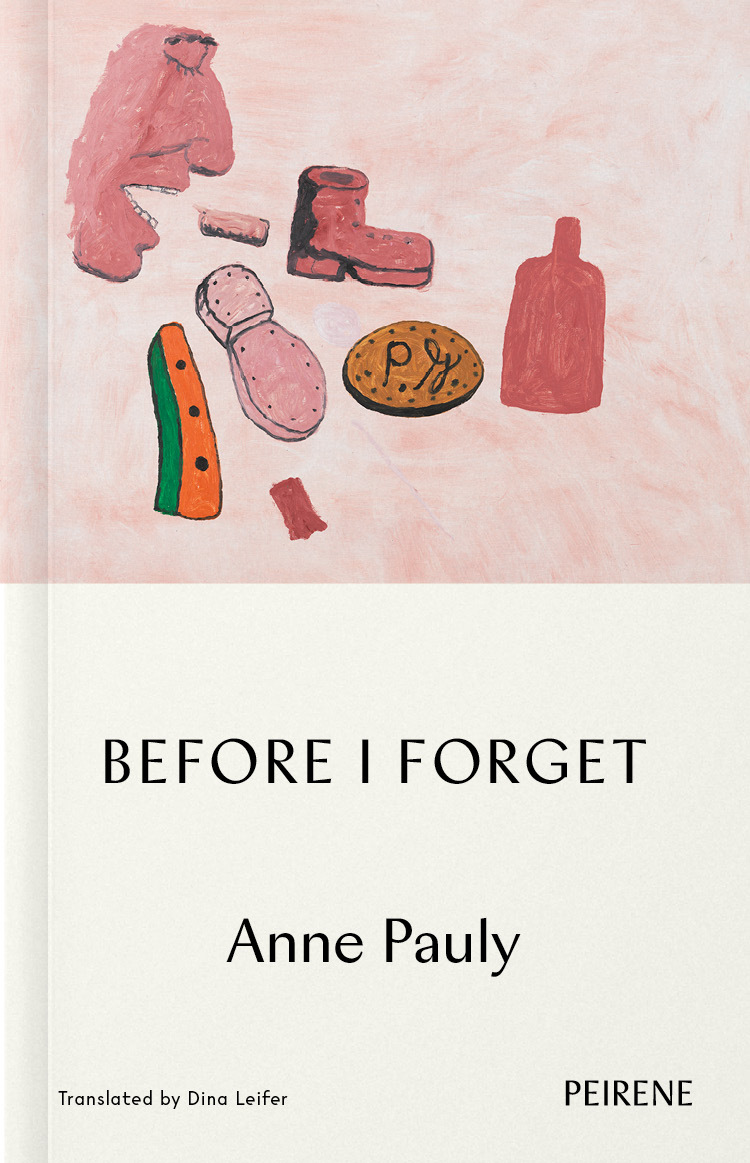
Céline Dion’s 2012 song ‘Parler à mon père’ (Talk to my Father) begins Je voudrais oublier le temps – I’d like to forget about time. Before I Forget by Anne Pauly, stylishly translated by Dina Leifer, is an elegiac novel that captures how death affects the texture of time, the ways we mourn for presences that caused pain, and how in our frail and human manner we negotiate with life after loss. One of the emotional apexes of the book comes when the narrator sobs along to Dion’s song, each platitude a small puncture.
Before I Forget was first published in 2019 by Éditions Verdier as Avant que j’oublie and was awarded the 2020 Prix du Livre Inter and Prix Robert Walser, and shortlisted for the Prix Femina, Prix Wepler and Prix Goncourt. The novel is about an editor named Anne Pauly, her brother Jean-François, and the illness and subsequent death of their father Jean-Pierre, on the eve of All Saints Day. The book is narrated by Anne and follows her as she grapples with her ailing father’s illness and, eventually, his funeral arrangements, as well as the colossal work of dealing with his belongings and the family home in Carrières-sous-Poissy, in the Yvelines department just west of Paris. The book is a work of fiction, yet Pauly is evidently at play with the genre and with our notions of autofiction. What is interesting about the author and the narrator sharing a name is precisely that it isn’t interesting, or dwelled upon even for a moment; once the reader can accept this, they can move through the narrative with ease. Anne the author/Anne the character become not a statement on the distinctions we make between fact and fiction but a mode through which the humour and futility of these distinctions can be exposed. As Anne says when she first encounters her father’s corpse, “It was sad and funny” – like genre, like life.
Before I Forget portrays death in its grim familiarity, but also in its all-encompassing destruction. Anne is forced to confront how “Life in all its ugliness and absurdity, went on as usual. And it was awful.” Herein lies the moral reckoning of not just the novel but of death itself. The prose is precise and the story universal; Pauly’s humour pierces through even the densest and foggiest moments of grief, offering relief and the occasional full-hearted chuckle: “That was the day my last tears flowed. I’d finally accepted it. If you’d told me that one day Céline Dion would help me navigate a rite of passage like that, I would not have believed you. Catharsis by pop music – check.”
Though Before I Forget hinges upon the death of Anne’s father, this death is also a vehicle for other modes of processing. When he dies, Anne can reflect on the adversity of her childhood, in which the moods of her alcoholic father reigned supreme, “If things turned too sour in the evenings, we got in the car and drove around as long as it took him to calm down.” In mourning her father, she mourns too for her mum who she describes as saintly and the childhood that never was because it was marked by violence, “he never expressed the slightest regret for what he’d put us through, even denying that we could have been scarred by it”. Anne is able to look at her highly problematic father and his faults head on while acknowledging the role reversal that their relationship depended on to thrive. “It was always him who needed taking care of,” she says.
At the same time, Anne is able to make space for her own feelings of guilt and grief. In one of the more heartrending episodes in the novel (a novel of many heartrending episodes), Anne comes across a book she once bought her father and is overcome by her own carelessness. “What a horrible, selfish cow!” she thinks. She notices how her father’s bookshelves are filled with “ill-chosen titles bought the day before Christmas Eve in overcrowded branches of the FNAC bookshop” but upon discovering her own contribution to this collection, sadness overwhelms: “Sometimes we don’t pay proper attention and then it’s too late, people are dead. Japanese Menus for Two! What was I thinking, when he was alone! It sounded like a promise of sushi for two: one I hadn’t kept. Like so many others.” Two things can be true: her father was largely horrible and she misses him terribly; these are the two realities that Pauly (the author) very successfully evokes. In Anne (the character), there is space for both the daughter who bought Japanese Menus for Two and also the daughter who feels terrifically guilty about it.
One of the other primary accomplishments of Before I Forget is its very precise depiction of the way death quickly becomes a negotiation with stuff. Death is many things, but one of its main repercussions is simply moving things around: “We weren’t clearing everything out, just tidying it, putting it in order so we could see things more clearly”. While Anne wants to go through everything, dwell on the past and linger there, her brother does not. She sees sorrow as “something we could have shared gently” but Jean-François, in his own pain, wants to get rid of everything and move on. “The idea of getting rid of things was predicated on them being a burden to me, yet that wasn’t the case at all,” Anne thinks—it is as if retaining the burden of his belongings is a way to prolong her grief and avoid the reality of her father’s death. In a moving passage Anne imagines keeping everything and putting it into storage but then immediately pictures how depressing the drive to the storage facility would be, “an unfamiliar suburb, in an industrial zone only accessible on Sunday afternoons via a B road bordered by advertising hoardings and unimaginably ugly roundabouts, all of which would not encourage the contemplation of memories, or their poetry”. The drabness of a Sunday afternoon makes the sentiment all the more acute. Pauly is very good at encapsulating these particularly bleak shades of sadness.
The discordant notes of death, the discomfort of hospital rooms, the clung-to ritual of shaving because dignity must be preserved, the pre-death thirst that can’t be quenched and finally the funeral mass that you want to end but which never seems to—all are so exactingly outlined in this short and moving book. There is an undeniably expansive nature to the narrative, which I believe is due to its ability to inhabit forgiveness and occupy multiple truths. When trying to choose what to read at the funeral, the priest (who has known the family for many years) gives Anne permission not to idolise her father in his death, “Funerals aren’t necessarily about glorifying someone. I think it’ll be good to read this text, because it’s about engaging with others and gladly giving the best of yourself and your father sometimes struggled with that side of things”. You can honour someone by representing the truth of who they are, and this book does just that.
At an earlier moment with the priest, Anne confronts the ways the Church is “so blind to the modern world”. When asked if she has children Anne considers replying “No, Father, I drink far too much to care for small children … No, Father, I saw my mother suffer and be abused so at the age of nine I decided it wasn’t the life for me. Or even, No, Father, I’m a big barren dyke because the patriarchy won’t let me have a family with whoever I want” but instead says nothing, realising, “the poor man had nothing to do with all that. Under the circumstances, destroying the patriarchy seemed particularly pointless”. Humour and pain are always intertwined in this book, often in the same sentence.
The loss of their father draws the siblings together and apart, brings new faces into their lives and forces a confrontation with the past, even if not entirely desired. Anne the character wades through the rhythms of grief and Anne the author puts words to this experience. Navigating the loss and its aftermath, Anne asks herself: “What direction should I take from the middle of nowhere?”. Perhaps because of its economy, I think this is a perfect summary of grief—where exactly can you go when you have nowhere to start from? The conceit woven into the lyrics of ‘Parler à mon père’ is that everything the singer wants is impossible: talking to her father is as unattainable as her other wishes, which include reaching for the moon and forgetting time. In Before I Forget, death happens, what Anne the character and Anne the author must reckon with is its impossibility. Anne the character wants to know “what to do with my life and what direction to take to prove I deserve what’s been left to me, without losing myself on the wrong path out of loyalty to a past which is, essentially, dragging me down?” Anne the author holds her hand on the path out of nowhere. Death, time, shitty Christmas gifts, an alcoholic father, these can exist at the same time as life, progress, care, a good mother. All of these things will continue to occur at the same time, while we watch, sometimes standing still, sometimes moving forward, but always wishing to talk to someone no longer there.
If you enjoyed this article, please consider supporting our work. You can also subscribe to our newsletter here: