Book Review
Scott Galloway
Notes On Being A Man
The latest self-help tract from the bald podcaster fails to question even the most orthodox masculine conventions, hammering home norms that his society has long since ceased to reward.
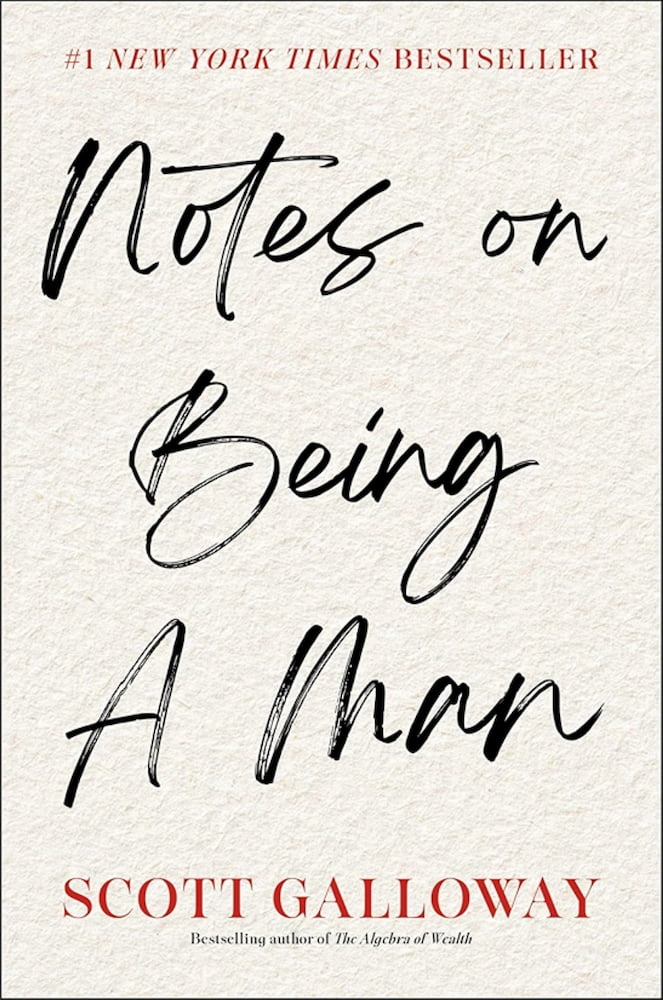
Anxiety about a supposed lack of positive representation for heterosexual men in popular culture has led to a steady thrum of articles, books, YouTube videos, and documentaries all asking, what is wrong with men? Where are they? What is happening to them? Where are their stories? Versions of these questions, as well as attempts to answer them, have in recent years become abundant. Many responses seek to link this lack of visibility with a general masculine alienation, observable in the rightward shift of young men thought crucial to the Trump victories of 2016 and 2024, and to the general rise in far-right violence across Europe. Scott Galloway opens his latest book, Notes on Being a Man, with a classic example of this concern. “If we can’t convince young men of the honour involved and the unique contributions inherent in expressing what makes them male,” he writes, “we’ll lose them to niche, rabid online communities.”
If the breakout moment for this discourse can be traced to the emergence of Jordan Peterson in the middle of the last decade, then Galloway’s book can be seen as the latest in a series of facile self-help screeds aimed at a supposedly lost generation of young men. Galloway, a podcaster, professor, and millionaire entrepreneur, has established a sizeable audience across a prolific media and business career. He describes himself as a communicator, and means that he is a marketer—someone who knows how to get up in front of people and hammer home a message they will remember. Notes on Being a Man, which is essentially a memoir cut through with droppings of sage wisdom, is a motivational speech aimed squarely at teenage and college-aged boys. It is a guide to life in the Peterson mode, though rather than directly laying out rules to be followed, Galloway explains how he continually broke all the rules he is here exhorting other men to follow. It is only now, having amassed both fame and fortune, in large part because he didn’t follow these rules, that he feels compelled to tell others how important they are.
What exactly are the rules? Grounded (if that’s the word) in a blithely pseudo-scientific conception of human nature, Galloway’s views on gender are in essence no different to the much-more-outwardly conservative Peterson. There are, Galloway claims, “certain givens about what it means to be male.” (For Galloway, biology may not be the whole of destiny, but it is certainly a large and telling part.) These “givens” are helpfully boiled down to a neat triumvirate of ethical demands: “protect, provide, procreate.” These are the ends to which Galloway’s ideal masculinity is directed. More men are failing to live up this ideal, he suggests, because the society they are growing up in offers so many addictive substitutes for the longer-term satisfactions of hard work, dedication, marriage, and fatherhood. Galloway’s outlook would not have been out of step with mid-century mainstream American values: a man should aim to be strong, stoic, generous, protective, well-turned out. (Galloway has an odd tendency to comment on how “handsome” men are—he notices this, and often compares men against each other on this scale.) It is no surprise to see Galloway refer to the American G.I.s of the Second World War as “Peak Male.” “When Germans or Russians are streaming over the border or firing from the beach, big-dick energy isn’t just a nice idea,” he writes, “it’s fucking mandatory.” As Jessica Winter has noted, “it isn’t clear which border the Russians were crossing, or if he realises which side they were fighting for.”
Like many who nowadays idolise the uniformed hero, Galloway himself is far from a military man. The closest he ever seems to have come to combat is his rowing team at UCLA in the early 1980s. Since then, Galloway has largely been an entrepreneur, moving from a starter job at Morgan Stanley (which he freely admits lying his way into) to a series of dot-com era startups, marketing consultancies, and hedge funds. He has been professor of marketing at NYU’s Stern School of Business for over two decades, and host of numerous successful podcasts, all while serving on the boards of companies like the New York Times and Urban Outfitters. His voice even made a cameo in the latest season of The White Lotus. He has lived his life, in other words, in the cradle of American capitalism, borne along by the waves of technological advancement and the investment it attracts. He is, in this way, the model American man of his generation. Given a world-class public education at the taxpayer’s expense (he repeatedly mentions their “generosity” in providing this for him), he turned that training into a lucrative career in private industry. Now, his accumulated wealth finally allowing a little time for reflection, for “giving back”, he ponders his life, what lessons it has for us, and what it can tell us about the world today. Why, he wonders, are things going so wrong (for everyone else)?
Galloway is a classic and proudly patriotic Democrat: he believes fervently in the post-war miracle of the American middle-class, and the great accumulation, through struggle and ingenuity, of life-securing wealth; he believes, still, in the American dream. He is critical of tech companies, whom he sees as predatory, and has called for the break-up of the Big Four (Alphabet, Amazon, Apple, and Meta) because he correlates their outsized success with the falling income share of that traditional middle class. They, and the wider Silicon Valley tech scene, are too powerful, too vast, for the rest of society to oppose, much less claim its “fair share” from. And if the mythologised middle-class is in decline, then no-one, Galloway suggests, has “fallen farther, faster” than men.
Notes on Being a Man has nothing whatsoever to say about resisting the forces that have caused this fall; instead, it focuses on learning to cope with those dynamics, and perhaps even succeed in spite of them. For a man who says that he is obsessed with politics, there is remarkably little political opinion in this book. It is, rather, a very strange text in that, despite all his stat-padded bluster about the state of things, it seems like Galloway doesn’t really want anything to change. What he’s asking for, in the most individualistic way, is for men to get to grips with their society, to rise to the challenge of an ever more competitive and punishing system, through the age-old tenets of discipline, dedication, ambition, and what we might as well call derring-do. Galloway does not question the correctness, or even the applicability, of the most orthodox masculine conventions; his advice is entirely about living up to those norms in a society that has long since ceased to reward them, even symbolically.
There are two major flaws in his method. Firstly, as mentioned above, the examples from Galloway’s own life, intended as semi-comic warnings of what not to do, only illustrate the hypocritical nature of his message. “I haven’t devoted my life to being a good man, a good citizen,” he admits, “when I was younger, my sole focus was on becoming wealthy.” The story throughout the book is of someone who got to the top through selfishness, dishonesty, and a maniacal focus on status and money—and now that that has all worked out so well, he’s in a position to deal out humble-bragging nuggets of insight to the poor shmucks denied the same freedoms and opportunities. He fully admits the pivotal roles played by luck, timing, and location in his success, and then advises others to follow a path of rigorous self-discipline, all the while lecturing on the importance of personal responsibility. His goal is not to change the terms by which ideas like success or even masculinity are defined, but merely to generate more men who are well-adjusted to the needs of the world as is, men who meet the demands of nationalism, social dominance, and capital. He just wants a little more redistribution to make adherence to the status quo more palatable for more people. This, as he sees it, is key to a stable society. “There is nothing more dangerous than a lonely, broke young man,” he writes. “It’s a malevolent force in any society, and a truly terrifying one in a society addicted to social media and awash in guns and loutishness.”
Secondly, Galloway’s attachment to traditional values means that he cannot acknowledge any connection between those values and the negative outcomes of the culture they create. As he puts it in one of the many infuriating “notes” that pepper the text (distilled summaries of the previous few paragraphs), “Note: there’s no such thing as ‘toxic masculinity’—that’s the emperor of all oxymorons. There’s cruelty, criminality, bullying, predation, and abuse of power. If you’re guilty of any of these things, or conflate being male with coarseness and savagery, you’re not masculine; you’re anti-masculine.” How convenient, this redefinition. It is a pattern that repeats throughout the book: the military stands for order, respectability, bravery; not for violence, abuse, waste, or countless other offences against humanity. Capital is the great tide that lifts people like him out of poverty, not the machine which enforces poverty on others. Real men – a term he has no problem using – protect, provide, and procreate (patriotically, and without protest); those who break such codes of honour and valour are hardly men at all, but mere scoundrels and dogs.
To say the philosophical thrust of the book is confused is generous—there is no philosophy here, no deep consideration of gender, no reflexive or nuanced thought. There is only a series of excuses for past bad behaviour (“These days, whenever I’m accused of saying anything sexist, my response is ‘Don’t you realize how far I’ve come?’”), a faux-humble mea culpa for belatedly waking up to the benefits of empathy and generosity (“Until I was financially bulletproof, I put myself first. I didn’t do anything for anybody or give money to anyone unless it could benefit me.”), and a familiar paean to make American men great again. How is that greatness to be defined? How can it be recovered? What forces are impeding it? What structural changes might encourage it? These questions, and many others, are left largely to the reader’s imagination.
“I consider myself a scientist,” Galloway writes, meaning “social scientist”, and he mobilises a range of studies, polls, and reports to back up his theory that men in particular are struggling in America today. Jessica Winter, in her review of the book, goes to some lengths to show the fallacies at the heart of that argument, enumerating the ways in which the problems now facing some men have long been issues for many more women. Why, then, should the problem be framed in terms of gender? For Winter, the loss of status perceived by such men is little more than a feeling “that men should still rank above women in the social hierarchy, just not as much as before.” There is no doubt that the vast majority of what counts as discourse in the manosphere, and in Galloway’s account of his own life, is rooted in fear: fear that one is not manly enough, strong enough, attractive enough, rich enough—these are fears that Notes on Being a Man does nothing to dispel. From this fear is born a horrifying welter of anger, misogyny, exploitation, and violence. For Galloway, the solution is solid relationships with women (who supposedly provide “guard-rails” for young men), rewarding work (such as building the Hoover Dam, the Empire State Building, or, presumably, a tech company), and a militaristic faith in America.
Underlying all this fear, however, is an even more sickly, pervasive concern that Galloway cannot address, perhaps because there is so little in his largely charmed life that would allow him to understand it: the knowledge that the odds are stacked against you. That the punishing rigidity and narrow-mindedness of modern capitalism might alienate broad swathes of people who cannot see any way of progressing with their lives, who are denied any opportunity for such progress and who feel cut off from the very things the loudest voices are telling them they should have, be, and want. That many do not want what they are told to want, or do not want it enough to justify the increasing levels of sacrifice and adjustment required to attain it. That many people perceive their society to be one of rackets, gambling, and corruption, a rigged affair laughably removed from meritocratic reward. This more ambiguous reality is not part of Galloway’s story. (Neither is the word “union”: he lionises the frat house but has nothing to say about organised labour.) He cannot accommodate ambivalence toward his mythologised middle-class ideal of the suburban home, the corporate job, the nuclear family; he cannot see the many ways in which that fantasy has been undermined by the institutions purporting to enable it. The story Galloway is trying to tell, the moral he’s trying to sell, is that the dream can still work out for an American man if he is committed, if he has faith—elders like him have a duty to communicate that message to the next generation. But, as Paul Goodman wrote nearly seventy years ago, during another panic about delinquency, “Perhaps there has not been a failure of communication. Perhaps the social message has been communicated clearly to the young men and is unacceptable.”
For Galloway, a good man is essentially a man who is good for capital; a man who provides, as he repeatedly says, “surplus value”: “They give more love, hope, and encouragement, pay more taxes, and create more jobs than they get back.” Such people do this “from a place of kindness, generosity, and strength.” His vision is like that of a cheesy old Hollywood movie, in which some dastardly titan of industry realises, through the love of a good woman, that there is more to life than money and power. He expects, in turn, to be rewarded and respected for having had this epiphany—“Don’t you realise how far I’ve come?” Galloway’s book only shows how little distance has been travelled, and how much further there is to go.
If you enjoyed this article, please consider supporting our work. You can also subscribe to our newsletter here: