Book Review
Doireann Ní Ghríofa
Said The Dead
Depicting the material, emotional, sensory and physiological realities of both present and past, with close attention to the natural environment, Ní Ghríofa does not shy away from the visceral detail necessary for making her subject's worlds come alive.
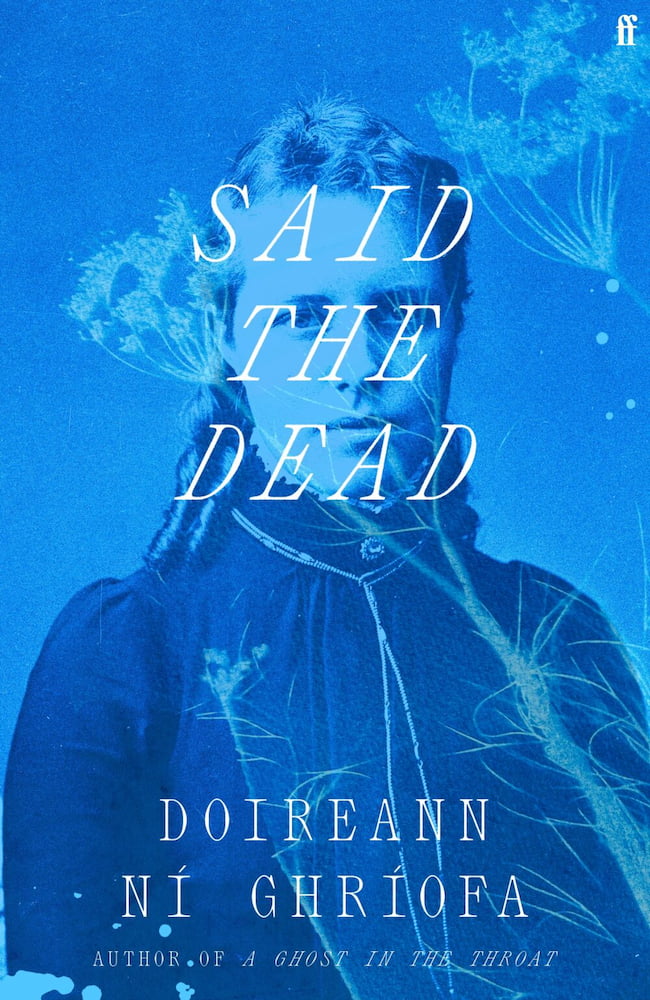
Doireann Ní Ghríofa’s new book bears some similarity, in many respects, to her 2020 prose debut, A Ghost in the Throat. Both blend autofiction and biography to stunning effect, with a vivid account of a life from the past emerging through a narrative of the instincts, research, labour, exploration and discovery that gave way to that account’s existence. And in each case, it is the textual output of a woman from the past that piques the curiosity of the protagonist-biographer, and provides her with a portal through which she can enter, reconstruct and beautifully, openly embellish that woman’s lived experience.
In its narrative devices, however, this latest work operates quite differently. A Ghost in the Throat reads as an extended personal essay, directly and precisely told in the first person by its protagonist-narrator. Said the Dead, meanwhile, features a protagonist that strongly resembles the author, but she is conveyed in third-person perspectives, of varying degrees of closeness, and her tale is occasionally punctuated – making expressive use of the page – by the speculations and analyses of a nameless, first-person observer. As a consequence, aspects of the narrative may initially appear hesitant or hazy. With continued reading, however, it comes into sharper focus, and this approach allows Ní Ghríofa to experiment with time and voice, and the stability, flexibility, unreliability and possibility of the written word in revealing, examining and documenting a life.
The text that A Ghost in the Throat hinges upon is a 36-stanza eighteenth-century Irish-language caoineadh, or lament, composed by Eibhlín Dubh Ní Chonaill. The body of text that becomes the driving force of Said the Dead is much larger, and more heavily populated: it is several decades’ worth of casebooks, starting in the 1890s, which document the observations of patients at Cork District Lunatic Asylum’s female wing, made, for the most part, by one of Ireland’s first female psychiatrists, Dr Lucia Strangman. But whereas in Ní Ghríofa’s earlier prose work, the lament is a text long known to the protagonist, these casebooks, and Lucia’s life and work, are discoveries prompted by a literal reconstruction, one that might have functioned as an act of total erasure, and instead – due to the diligence, care and artistry with which this book is constructed – sheds light.
In its opening pages, the protagonist is drawn to explore the site of the ‘derelict mental hospital’, which has been partly converted into apartments, and is now undergoing further development. Of the building, she acknowledges that, ‘had her birth occurred in a different decade, she – whose distress had twice sent her clambering river railings seeking her ending – might have lived within those walls’. The hospital’s chapel is in the process of being carved up, repurposed; wandering its perimeter, a bramble catches her ankle, and she spots something:
Pushing those briars aside revealed a single splinter of stained glass, bright as a ruby and warm as blood. Under a pair of crumpled beer cans, she found more shards, golds and pinks and greens, some grime-crusted, some still connected by lead. Digging them from dirt, she felt the bite of their sides and thought teeth, thought mouth, thought song, then speech. The vapours that had risen from warm bodies in the pews would have lifted syllables mixed with candle-soot, distilled as condensation on the chapel windows. Every one of these fallen fragments would have known the touch of such vapours, before being flung into this world of briar and rain, the fleshy slip of snails.
She takes these shards and small panels with her, and returning home, trips on the footpath; one panel smashes, making an ‘L’ shape of the remaining lead – which she takes to be a sign.
Throughout this text, there is a sense of the protagonist being guided by something external to herself, a porousness between the past and the present. She continues her exploration of the site, first via its archives. There, she becomes immersed in the pale blue pages of the casebooks, in which the doctors working at the hospital kept a log of their assessments of the patients.
In these accounts, there is frequent repetition of the word ‘says’, with the patients’ statements presented as glimpses into their past, their inner reality, and grounds for their prognosis. The protagonist is wary of what she views as ‘cold portrayals’ and reductive notes regarding the patient’s state, and conscious, too, of the limitations and insufficiencies of this type of record, where ‘no one could say “on second thoughts”, or “not anymore”’ – ‘once someone said something in those blue pages, they said it forever’. And yet, as she reads on, the patients themselves – their ‘troubles and desires, longings and distresses’ – start ‘spinning from the text into her mind, where they were alive’. And when a patient’s statement reveals to the protagonist that the doctor writing that record was also a woman, the protagonist is taken aback. On her discovery of Lucia’s existence, the protagonist becomes ‘the Reader’ – consuming anything she can find that will allow her to seek out an understanding of who this woman was. She is compelled to follow Lucia, the journey of her life and her work, and the lives of the many female patients under her care.
In transcribing these accounts, the Reader is diligent not to lose a word ‘to the ravine between casebook and her notes’. It is, however, the empty spaces between and beyond those lines that most intrigues the protagonist, and drives the narrative on. In A Ghost in the Throat, the narrator states that her ‘favourite element hovers beyond the text, in the untranslatable pale space between stanzas, where I sense a female breath lingering on the stairs, still present, somehow, long after the body has hurried onwards to breathe elsewhere.’ The focal text of Said the Dead, being an archive, is full of gaps that invite speculative imaginings, and though one of the through-lines of the book is Lucia’s biography, there are multiple biographies nested within it, of the women who came to be patients at the hospital, of their pasts and their outcomes.
Ní Ghríofa is gifted at depicting the material, emotional, sensory and physiological realities of both present and past, with close attention to the natural environment, and she does not shy away from the visceral detail necessary for making the patient’s worlds, and that of Lucia, come alive. The life of a shared bedroom is conjured by ‘twin dips in pillows’ and ‘whispering after dark after quenching [a] shared candle’. A grieving teenager observes the seasons pass; at first, ‘the city, iced in frost-skins, echoed her pain, until it betrayed her with snowdrops, jaunty and wrong, and what followed was worse, the drooling yellows and purples of crocuses, and then, worse still, the bad bright sunshines of April and May’. A post-mortem, in which a skull is sawn open, is described as ‘bowl of bone – tilted to the light … the rare, rosy lustre glimmering inside’.
While this allows us to inhabit these worlds with ease, the worlds themselves are not easy; among and within the patients, there is pain, terror, neglect and self-destruction, during a time when tuberculosis was rampant, and when medical interventions we are presently lucky to take for granted simply did not exist. And yet, shot through the text – and not just in the courses of the patients’ lives charted in the casebooks – is a sense of what it is to provide meaningful care; the diligence, humaneness, consistency and relative detachment required to truly observe, and encourage and facilitate, where possible, progress and recovery. It is a surprise, given the extent to which early twentieth-century psychiatric hospitalisation is associated with incarceration, to read multiple instances of patients being observed as much improved, leading to their being declared, in the casebooks, as ‘Discharged Recovered’.
The book is both deeply serious in its content and engagingly playful in its narrative mechanics. Whereas in A Ghost in the Throat, the protagonist is accustomed to ‘inviting the voice of another woman to haunt my throat a while’, in Said the Dead, the direction of travel is reversed; the protagonist inserts herself as a ghostly presence into the lives of the past, ‘leaving the living to seek the dead’. A dialogue forms between her voice, that of Lucia, and ‘the wild choir’ of those who inhabited the hospital, between her versions of events, and historical accounts; on occasion, they knowingly, gently contradict each other. It is also strongly suggested, throughout, that her fascination with these lives is a form of refuge, salvation in a time of great need, and an attempt to retreat from the pain of a terrible loss, which is alluded to but never explicitly discussed. The protagonist pays very close attention to the physical site of the hospital, seeking to detect and draw out its stories, its energies and emotional states – ‘what’s left is what’s felt’ is an expression that comes to her, in doing so. It is made clear, however, that this type of venture holds great risk, that her excavations of the hospital’s past – which include making frequent, physically risky visits to its dilapidated, mid-demolition spaces, hoping to ‘read that rubble’ – could end up trapping her, incarcerating her.
Compared to Ní Ghríofa’s earlier prose work, Said the Dead may initially appear fragmented and deliberately elliptical. It’s a narrative that the reader must sink into before it can gradually rise, line by mesmerising line, to the surface, and which, by its close, makes perfect sense of the form. A refrain, ‘call it an archive’, echoes through the text. Like those shards of stained glass, the author has used surviving fragments to diffuse warm light on pasts and realities that have been too often deliberately obscured, omitted and forever lost from us.
If you enjoyed this article, please consider supporting our work. You can also subscribe to our newsletter here: