Book Review
Vigdis Hjorth
Repetition: A Novel
Hjorth draws liberally from her personal life and pours it shamelessly into her writing, taking seriously and rigorously the arduous task of dredging up hazardous objects of memory.
When Elfriede Jelinek, winner of the Nobel Prize for Literature in 2004, was asked in an interview if she regretted the fact that her mother did not live to see her success, the author promptly replied: ‘Oh, no. I’m glad that terrible woman is dead.’ Her answer makes more sense when we think of her most famous (and most autobiographical) novel, The Piano Teacher, which explores the violent, tempestuous relationship between a tyrannical, overbearing mother and her awkward, musically-gifted, sexually-depraved daughter. Erika, the teacher, is tormented by her mother, with whom she shares a desultory existence in a cramped apartment in Vienna. She is hounded, questioned, searched, belittled, and forbidden from partaking in even the smallest pleasure: in the opening pages, the mere purchasing of a dress is enough to provoke her mother’s unchecked wrath. Rage and resentment fuel the novel, filling its pages with suffocating walls of text. There’s no way out: if she is not a slave to her mother, she’ll be a slave to a man, and in the end everyone’s a slave to capital. Vienna, in its pages, emerges as a cesspit of human degradation where the worst behaviour is not only permitted, but actively encouraged. Erika stumbles upon orgies in the park, is chased through the woods, gleefully terrorises her students, and begs to be brutally abused. It would be an unbearable read if it weren’t for Jelinek’s rambunctious and rambling prose, her moody digressions, her lethal if heavy-handed use of irony (in that same interview, she calls herself, in something of a self-own, a ‘writer of the axe’). She followed it with another novel, a tale of murderous adolescent psychopaths running amok through the 50s, called Wonderful, Wonderful Times – heavy on the wonderful.
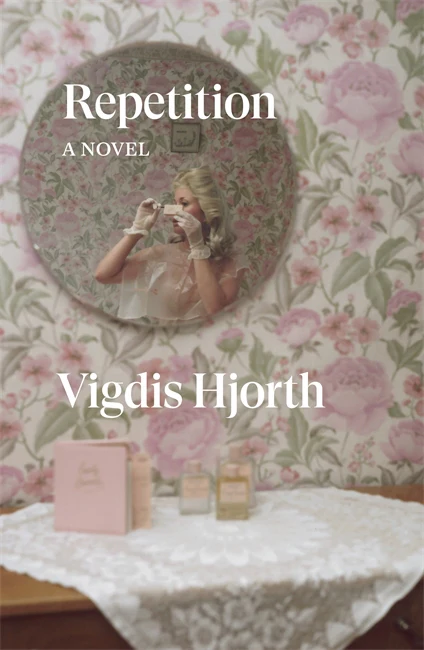
Repetition, the latest novel from Norwegian author Vigdis Hjorth, may not be the most obvious descendant of Jelinek’s, but it does share some similarities with The Piano Teacher: both are set in the 1970s, centre on artistically-talented daughters relentlessly oppressed by their mothers, and are heavily (and openly) autobiographical. But where Jelinek’s book is, at the end of the day, a work of fiction, Hjorth’s is a more meditative and interior work of recovered memory. When the narrator, a middle-aged author, attends a carol concert in present-day Oslo, she sees a gloomy teenage girl bickering with her parents in the seats next to her. The parents want the girl to remove her coat, which she eventually does, rather adolescently, with begrudging and contemptuous slowness. She gets stuck, so that the jacket sits half off and half on, ‘like a weird straitjacket’. The preposterous sight triggers in Hjorth a sudden stream of recollections from her own teenage years, some of which are short as a paragraph, others long, breathless and unbroken. Throughout these sketches, her mother appears as a narrow, brittle figure, perpetually anguished and framed in the window, like a Munch painting, waiting anxiously for her daughter to come home. She is judgemental, smothering, all pinches and tears and pieties; she interrogates her daughter every time she goes out, then sniffs her for cigarettes when she returns. There is more than a shade of Erika’s mother here, the jealous, obsessive ‘mama’ who rings her daughter while she’s at work. Hjorth’s narrator’s mother, too, rings her wherever she goes or claims to be, hoping to catch her in a lie.
The girl, who is sixteen in these memories, and who has never even been kissed (we see her practicing with her hand against a mirror) can do nothing to assuage her mother’s fears. Naturally, she begins to live up to them. She starts lying, drinking, and spending time with boys; she arranges to meet one of them, an older boy called Finn, and together they go on a date to her school, the gloomily named Berg College. She writes: ‘When I saw the big building, I slowed down on realising that I had never been there in the evening, how different it looked now, deserted and its windows dark, the lights were only on in the sports hall.’ It’s a simple but striking image of the abrupt upheavals that constitute the sensorial topography of burgeoning adolescence; the school, mysterious and brooding, is charged with nocturnal menace and enchantment, like a beautiful, hulking moth. She walks toward it as if spellbound. How different it looked now. The narrator, like every adolescent ever, is desperate to undergo a transformation of her own, to become unrecognisable, to be looked at as if spellbound. She arranges to meet the boy at his house while his parents are away. She looks at herself in the bathroom mirror and kisses her reflection goodbye, hoping for ‘a transformative action that would strip away this stupid face.’ Her vehemence is made all the more alarming by the failure of the event, no matter how disappointing, to do so. It is at this point where the novel veers into murkier territory. Hints of an unknown horror lurk at the edge of recollection, darting between sentences like sharks. When her parents find out what she did, their bizarre reactions alienate and frighten her. She finds herself alone and paralysed, and we find ourselves right back where we started, looking at a girl, powerless and miserable in the dark. The novel skips like a record. This has happened before.
Freud had a thing or two to say about repetition. ‘The patient repeats instead of remembering,’ he wrote. ‘The patient does not remember anything of what he has forgotten and repressed, but acts it out.’ In psychoanalysis, bringing the compulsion to repeat into the field of treatment can turn it into a ‘motive for remembering’. This can be a dangerous process, depending on the nature of the repeated act, but the goal is to neutralise the act, render it harmless, and use it as material to ‘work through’. A process, just like writing. Like rewriting.
Some writers – too many, really – claim that writing is ‘therapeutic’ (it is not) when what they probably mean is that the task makes them feel good or that it relieves them, however temporarily, of the stress and perturbations of modern life. That’s fine—so does jogging. I don’t know what the goal of therapy is, but I know it’s not ‘feeling good’. Psychoanalysis, writes Janet Malcolm, is a ‘process of blunting,’ a description which suggests a certain degree of effort, work, courage, and dedication as much as it does something sharp, hazardous, dangerous. It is hard to imagine any of these people taking the arduous task of dredging up, of bringing to light such dangerous and hazardous objects of memory as seriously and as rigorously as Vigdis Hjorth does in this book. Repetition is not just the title of the novel, it is its method and its form. Sentences, yes, but also images, scenes and motifs recur and echo throughout. Past and present melt; girl and woman blur. The text is a stage – quite literally, from the opening pages – for the author to rehearse, and keep rehearsing, to the point of exhaustion, this critical story from her past. ‘I repeat and I vary the repetition,’ she writes, ‘in order to change myself through repeating and varying patterns.’ It is a story she has told many times, in many ways, until once, after fainting while writing a particular passage, she sees that she did not say what she meant to say; suddenly, she remembers: ‘And the images came flooding in, unbearable images shot like electric shocks through my brain, lightning-clear and with the force of several thousand volts, and everything fell into place, my mind imploded and I have never been the same since.’
Like her fellow Norwegian Karl Ove Knausgaard, Hjorth draws liberally from her personal life and pours it shamelessly into her writing; many writers do this probably, and probably none of them do it half as well. But that is not what makes this book interesting. What is really being repeated here is a faulty system of secrecy, repression and control. The family unit, too often based on fear and shame, and too intent on maintaining the status quo, casually, cyclically destroys its members who give it life. How can anyone expect to grow under such conditions? Any system that requires conformity is going to cause suffering – but who says that’s what a family must be? This is a quiet, intensely personal book with implications that reach far beyond itself. It asks us to reconsider what a family is and what it’s for. To this question there are about as many answers as there are families; or maybe there is only one: either it is, or it isn’t, worth repeating.
If you enjoyed this article, please consider supporting our work. You can also subscribe to our newsletter here: