Book Review
Joana Masó
Tosquelles: Healing Institutions
Francesc Tosquelles worked towards creating environments in which every element had healing or ameliorative potential, where therapy might be a collective and collaborative enterprise, a fully social endeavour.
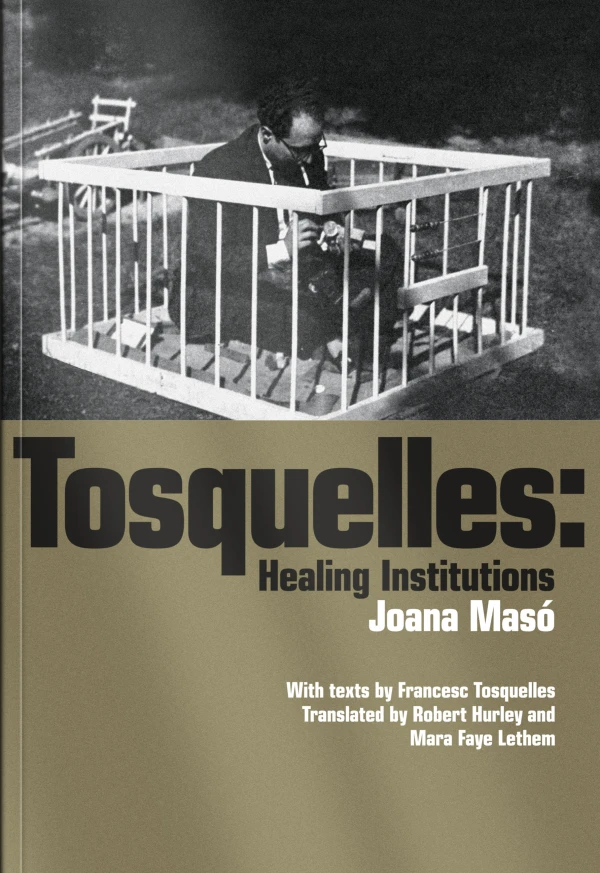
Tosquelles: Healing Institutions gives readers of English access for the first time to a broad range of the clinical and political writing of radical psychiatrist Francesc Tosquelles, illuminating his role in the development of institutional psychotherapy. In doing so the author, Joana Masó, a professor of French literature at the University of Barcelona and a researcher with the UNESCO Chair on Women, Development and Cultures, enables a direct encounter between the unended story of twentieth century fascism and our increasingly authoritarian present, giving readers a rich, timely and hopeful resource for reviving Tosquelles’ ideas and practices of healing the mentally ill, resisting oppression, and developing collective approaches to positive social transformation.
Francesc Tosquelles I Lllauradó was born August 22nd, 1912, in Reus in Catalonia, and was awarded an advanced medical degree in Barcelona in 1934. This was an environment that had absorbed the potential of psychoanalysis to positively transform the condition of the mad, partly as a consequence of analysts and psychiatrists who had moved to Spain, fleeing antisemitism in Germany and Austria. Tosquelles engaged closely with Jacques Lacan’s 1932 doctoral thesis on paranoid psychosis and took from it an understanding of the socio-genesis of madness and the possibilities of new approaches for healing. By 1936 Tosquelles was a member of the JCI (Juventud Comunista Ibérica/Iberian Communist Youth Party) in Reus. He was also in the orbit of POUM (Partido Obrero de Unificación Marxista/The Workers Party of Marxist Unification). In 1937 Andreu Nin, POUM leader and Catalonia Minister of Justice, was disappeared and assassinated, likely by Soviet agents acting under instructions from Stalin, as part of widespread purges of anarchists, socialists and communists critical of Stalin.
Tosquelles was a medical officer in charge of Republican mental health services during the Spanish Civil War, as lieutenant and later acting captain. After the fascists won in April 1939, Tosquelles briefly continued to work as a doctor under the new regime before fleeing on September 1st. After crossing the Pyrenees on foot into France he was interned in the Septfonds refugee camp where he undertook the profoundly courageous and resourceful action of establishing a psychiatric unit. In January 1940, he began working at Saint-Alban-sur-Limagnole psychiatric hospital in Lozère. By June, France was occupied by German troops and divided between direct occupied territory and the Vichy administration. During the occupation, up to 40,000 patients died in French psychiatric hospitals from hunger and neglect, aptly described by Max Lafont as the “soft extermination.” Saint-Alban was a striking exception to this brutal mortality of the mad, creating collective spaces and organisation directed at supporting life and extending patient autonomy. Furthermore, Saint-Alban became a refuge for Jews, members of the Resistance, and many artists and intellectuals, including Georges Canguilhem, Paul Eluard and Tristan Tzara.
At Saint-Alban, Tosquelles and others, including Jean Oury and Frantz Fanon, developed a new practice of institutionality that, according to Masó, “allowed desire to exist, as well as other ways of moving, of working, of being together and being alone.” A therapeutic approach that incorporated individual practice – what Tosquelles called “clientele psychoanalysis” – into an institutional practice that was collective and communitarian; this was neither therapy as a product sold to the bourgeois individual, nor a public service focused on the problematisation and enclosure of the individual mad person. Madness was seen as a human phenomenon and the role of healthcare “to integrate the mad, with all their humanity, back into society.” Tosquelles was convinced by Hermann Simon’s ideas that the patients could be cured by curing the institution—an activity which he felt should be at the centre of institutional therapy, a practice defined by Tosquelles as “free, personal and personalising… that originates and takes root in each individual.”
In established psychiatry and psychotherapy, therapeutic relationships were typically dyadic, practitioner to patient, the healing relation, a process reified into a product to be sold, excluding those without means. Such a practice ran the risk of turning the living relationship, within which healing might be possible, into a dead object of commerce. The relation hierarchised into well-wise-practitioner over problem-person, and the imposition of a mechanical metaphor, in the form of the afflicted person as a broken brain or mind to be factored into social functioning.
Institutional psychotherapy, as Tosquelles and his colleagues worked towards, was about creating environments in which every element had healing or ameliorative potential. This would encompass a range of medical and psychotherapeutic modalities, with many situations and opportunities created for a return of the mad person to a less suffering self that could relate better to the world around them. Tosquelles was inspired by the Catalan workers’ cooperative tradition in which, in his words, “it was not just a matter of fighting the bosses, but the way in which one becomes a boss oneself.” Within this mentality therapy might be a collective and collaborative enterprise, a fully social endeavour. During the Spanish Civil War, he stated:
I was able to create a true field practice consisting of therapeutic communities… mixing soldiers with civilians… we were doing psychiatry on site… with the help and participation of ordinary people—lawyers, country priests, crazies, farmers, painters… Only these people had an innocent position toward the mad, whereas those who had undergone professional deformation… were useless, were obstacles rather.
Tosquelles understood that the essential quality for helping the mad was knowing how to be with others, “knowing how to live, to engage in personal exchanges, to get along with others.” In conventional practice he found that “defending the role, the corporation, was more important than doing psychiatry”—“when I do something that can be called psychotherapy… I am not defending a status. The patient has no effective contact with me as long as they don’t forget that I am a doctor, or my social status.”
Therapeutic work, including ergotherapy (more commonly known in English as occupational therapy), was essential to this approach. In work – as in, actual labour: woodwork, cooking, digging a garden – patients might learn the rules of the practice, the reasons for the work and how it was done. Once these ideas of rules, apprenticeship, and practice were learned, or if lost reapprehended, they could be applied to other contexts, objects and materials, allowing persons and groups to function with less confusion and suffering, with more self-directed and group-directed control and satisfaction. Work could become a path to, and reformulation of, freedom.
Grounding institutional psychiatry in this way, Tosquelles felt that a space might be established for encounters that were open and boundaried, or, in his words, “empty, but limited.” He advocated “zones of freedom… Zones, plural… Being free means becoming responsible.” The institution needed people from a diversity of backgrounds, who brought with them different ways of reading the world. Institutional psychotherapy “exists nowhere,” Tosquelles wrote, and “there only exists an institutional psychotherapy movement, born and repeatedly reborn in classical psychiatric establishments.” That movement, he thought, must contest the “immobilism of the establishments” and their segregationist practices that deliberately place artificial barriers between inside/outside, social life/asylum life, normal/pathological, somatic/psychic, the individual/ the group, family group/ therapeutic group, past/future, “frozen statuses and accidental roles”, adaptive rationality and so-called unconscious irrationality, structure/history.
The ‘hospitalism’ of the traditional institution imposes silence, deference and compromise. According to Tosquelles, institutional psychiatry’s goal is movement in itself, “by which something of the patients’ desire, overcoming its distortions and its occasional blockages, may gain access to speech.” The care relation needs to be established “on the basis of acceptance of and respect for the unknown in human beings, whatever that otherness might be.”
“Madness is a creation, not a passivity,” he wrote, observing that as a precondition to becoming an effective psychotherapist, he must “rid myself of the notion of the basic strangeness of the mad.” At Saint-Alban, Tosquelles removed the window bars and other physical obstacles that were built in the hospital as a response to the fear of the mad, and enabled and encouraged the patients to roam and freely interact with others, including workers and neighbours to the hospital. The old, alienated institution was succeeded by a disalienated one. In Masó’s terms the institution became “a political laboratory” for experiments in social and individual freedom.
Individual and collective art practices of a wide variety were a key element of therapy at Saint-Alban. In 1948, partly as a response to the Nazi assault on supposed degeneracy and primitivism in modern art, the so called Entartete Kunst, Jean Dubuffet created the Compagnie de l’Art Brut, which included the work of Saint-Alban patients, including Auguste Forestier. For Jean Oury, Tosquelles’ colleague at Saint-Alban, the therapeutic value of art making was to be found in the patient’s reaching out to the world, the creation or expulsion of meanings that they could make sense of, together with their doctors or therapists, through which the afflicted could be activated into life, or at least experience a softening of their suffering. Oury did not accept the opposition between a ‘brut’ art—an idea with a flavour of Jean-Jacques Rousseau’s ‘noble savage’—and conventional cultural practice; he saw patients’ art practice as part of a totality of therapy with healing and not commodification as its end. With this came a wariness about the risk of patient exploitation, justified by the history of patients’ artworks after their creation as value-laden museum and collectors’ objects torn out of the contexts of pain and healing.
Surrealism had a significant influence on what Masó refers to as “the psychiatric avant-garde”, while also releasing the unconscious from its position as a purely clinical object through artistic practice with a strong political, liberatory valence. In this context it was unsurprising that practitioners would understand the radical social and therapeutic potential of art. As Tosquelles wrote:
One of the slogans of surrealism speaks of placing a sewing machine in a wheat field… The problem is how to integrate madness into the city… madness automatically entails phenomena of exclusion [and] social repression… Certain people are tolerated so long as the madness is masked as art. If a doctor leaves the hospital with the notion that he’s leaving madness behind, well, he’s mistaken… he goes into the sector, into the fields of wheat.
Tosquelles and his colleagues expanded the notion of the therapeutic locus far beyond the hospital, the clinic, the consulting room, giving rise to the notion and practice of the sector, which was not merely an administrative division but the entirety of a social space in which the hospital or clinic or consulting room was situated, with all its institutions, traditions and processes. Social therapy had to address the whole institution with: “[a] clear awareness that one can’t ‘heal’ the patients without healing the hospital structure.”
As Joanna Masó argues, anti-psychiatry, having arisen especially in Italy and Britain, resonated in Spain, “interpreted as a critique of the repression and censorship of Francoist society, of its prisons, its schools, its concept of family.” It was a movement about abolishing not transforming institutions, with a tendency, in its haste to end social domination, to minimise the immense toll of human suffering that comes with madness. The idea and practice of institutional psychotherapy was seen as, at best, reformist and at worst illegible, incoherent or useless in the face of the scale of the social and political challenges of fascism, and capitalism more generally, rather than a profoundly radical, collectivist approach to healing persons as well as medical and social institutions. As Masó has said, Tosquelles anticipates Gilles Deleuze’s conception of institutions as a positive model of action, a theory confirmed in our time as the degradation of institutions becomes central to the advancement of tyranny over democracy.
Masó builds on the work of Camille Robcis in her invaluable book Disalienation: Politics, Philosophy and Radical Psychiatry in Postwar France, returning Tosquelles to his Catalan and Iberian origins. In the last section of the book, Masó carefully maps the last years of Tosquelles’ career following the death of Franco in 1975, his interest in the ‘language turn’ as it related to psychology, through the work of Roman Jakobson and Roland Barthes, and the elements of his rediscovery as a Catalan as well as a figure of French intellectual life.
Masó writes: “I hope this book allows for both remembering and learning, inheriting and creating, at the meeting point between the memory we do not yet have and the imagination we lack, in order to tackle the problems and maladies within our contemporary institutions.” She succeeds in transmitting the world of Tosquelles’s ideas, practices and experiments, and, as importantly, his spirit of transformation and optimism about individual, collective and social healing.
Tosquelles’ work implies that humans cannot be well individually without social wellness, in all our institutions: family, work, education, culture. And, as has been evident for some time, without this human wellness we will impose our madnesses in their most destructive forms onto the totality of the natural and the social world. In this context, Tosquelles: Healing Institutions is a very welcome book of hope.
If you enjoyed this article, please consider supporting our work. You can also subscribe to our newsletter here: